Thursday, February 26, 2009

Early Learning Program

How the Books Works........??

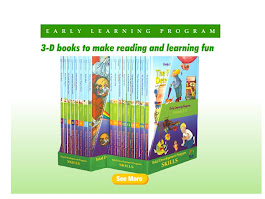
Books will develops 49 skills through interactive stories!
Main skills include :

  • The Alphabet and reading
  • Number and Counting
  • Primary and secondary colors
  • Concepts of time
  • Observation and cisual pereption
  • Thinking and Imagination
  • Problem solving
  • Social and emotional skills


And once you open a book it's hard to put it back

DESCRIPTIONS

Colorful, lively illustrations on every page - attract children and hold their interest, help develop their concentration and reading skills

Note to parents at the beginning of each book - explains what the book is about, how to make the best of it, and suggests additional activities

Interactive games to find hidden objects and animals - helps develop observation skills.

Riddles and poems - challenge your child, enhance reasoning and develop lateral thinking

With so many fun elements, this series is sure to become your child's favorite!

---------------------------------------------------------

BOOK TITLE

Consist of 17 books with hard covers, which are


1. HOUND BEE ; A mix –match imagination book
2. HOW MAY HIPPOS ; A mix-match counting book
3. THE GREAT ABC TREASURES HUNT ; A hidden-letter alphabet book
4. PURPLE PARROTS EATING CARROTS ; A read-the picture book
5. BALDERDASH THE BRILLIANT; A hole-in-the-page-color book
6. ROBERTO’s MAGICAL CLOCKS; A book about telling me
7. GUESS WHO?; A Lift-the-flap animal book
8. TALES FOR STORMY DAY ; A book about good behaviour
9. Mr BOOGLE’s PECULIAR DAY ; A what-do-you-see book
10. THE SECRET FOREST ; A lift-the-flap book
11. THE SEARCH FOR SEVEN SISTERS ; A hidden-in-the-picture geography book
12. THE FAMILY TREE ; A family history book
13. A PICTURE PERFECT WORLD; A hidden-in-the-picture nature book
14. VOYAGE OF THE MICRONAUTS; A book about the human body
15. TANYA TINKER AND THE GIZMO GANG ; A lift-the-flap discovery book
16. THE THREE STORYTELLERS OF OR ; A think-about-it book
17.THE BUMBLETOWN DETECTIVES; A problem-solving book


ALL the books are belong to Early Learning Program with area covers about SKILL
---------------------------------------------------------------


DESKRIPSI
· Ilustrasi berwarna dan hidup pada setiap halaman – menarik perhatian anak-anak dan mempertahankan ketertarikannya, membantu membangun konsentrasi dan keterampilan membaca.

· Catatan untuk orang tua pada setiap awal halaman buku – menjelaskan isi buku, bagaimana memanfaatkannya dan menyarankan aktivitas-aktivitas tambahan yang berguna.

· Permainan interaktif untuk menemukan obyek dan binatang-binatang yang tersembunyi – membantu membangun keterampilan observasi.

· Teka-teki dan puisi – menantang anak Anda, melatih memberikan alasan dan membangun berpikir lateral.

---------------------------------------------------------------------------------------------

FITUR PRODUK


- 17 buku hardcover

- 10 buku berbahasa Inggris

- 7 buku berbahasa Indonesia (termasuk buku dengan halaman bersirip, terbelah, dan berlubang)

- 1 Buku pedoman untuk orang tua- Penyajian dalam bentuk dongeng- Pojok Catatan untuk orang tua


Dengan elemen-elemen yang menyenangkan, membuat seri ini menjadi favorit anak Anda!

----------------------------------------------------------------

Cash Rp. 2,990,000 (US$300)


Credit (indonesian only) DP Price

3X Rp. 1,045,000 Rp. 1,045,000


6X Rp. 545,000 Rp. 545,000


12X Rp. 305,000 Rp. 305,000

For order and pricing call ihermawaty@gmail.com or motherteam.support@gmail.com
For any Detail click MotherTeam Timelife TiraOptima

Reading become fun with Us

MotherTeam®

So what MotherTeam® has….????

TOTAL DEVELOPMENT PROGRAM


Here we have TOTAL DEVELOPMENT PROGRAM (TDP).the programs are design friendly using consist of books, Cd, cassettes, pictures etc.the program focuses on developing all the areas of knowledge, skills and values for the total developments of your child. Here’s how it works.


For info amd order call ihermawaty@gmail.com or motherteam.support@gmail.com

Reading become Fun with Us

MotherTeam®


What Is Early Time Home Learning

WHY Good Schooling is not enough


1. The MOST formative years are before a child enters school.


BRAIN DEVELOPMENT :


- By 8 months , a baby’s brain has about 1000 trillion nerve connections. By the age of 10, that number reduces to just 500 trillion or less
- Early experiences impact the reduction in nerve connections. The brains on a “use it for lose it” basis
- Studies on neglected children who were rarely touched or spoken to, and who had little opportunity to explore and experiment with toys, had brain 20-30% smaller than most children their age

Did you know that language learning is a natural process during the early years?


During the first six months of life, babies babble using a combination of 70 sounds that make up all the languages in the world. They will then learn to talk using only the sounds and words they pick up from their environment. For this reason the first few years is the best time for a child to learn another language.


Pre-school years are vital years!

Fifty percent of the ability to learn is developed in the first four years of life, another 30 percent by the age of 8 and the remaining 20 percent by the age of 18. Everything we learn later grows from the patterns established during these years


The habit of reading and the love of learning are developed at home!


Reading skills are important

While knowing how to read is essential for day-to-day survival, developing a passion to read opens new worlds for children. By reading, children can acquire all the knowledge, skills and values essential for their success in school and in life.


Did you know that about 20 to 30 percent of school-age children have difficulties learning to read?
During early grades, their difficulties are quite embarrassing to them. This humiliation suppresses their motivation and self-esteem. Children who are most at risk for reading difficulties are those who were not read to at home.

Reading to your children...

- Is an integral part of teaching them how to read
- Makes it easier for them to develop their speech and language
- Teaches them new vocabulary and pronunciation
- Builds their listening skills and increases their attention span
- Stimulates their imagination and fosters their natural curiosity
- Develops their ability to express themselves more clearly and confidently in spoken and written terms
- Is a great way to prepare them for the school environment
- Is a wonderful bonding experience that nourishes emotional development

Reading to our kids molds them into readers, which significantly increases their potential for academic as well as lifelong success!

3. Your child spends more than twice as much time at home as in school!
- If your child starts kindergarten at the age of four, he/ she would have spent about 17,500 waking hours at home with you already! [4 years x 365 days x 12 hours = 17,520]
- On an average, each child gets only about 11 minutes of individual attention during a typical day at school?
[40 minutes / 30 children x 8 classes = 10.66]
- A child can often learn more effectively in the relaxed and casual environment of the home, where there is no peer pressure

That makes your home the most important place of learning for your child, and you your child's most important teacher, doesn't it?


Should children be reading or learning all the time?

No. Children need a balanced program that takes care of their physical, mental and emotional needs


On an average how many hours a week does your child spend in:
- front of a screen - watching television, playing video games, computer/Internet?
- physical activities - sports, outdoor games, etc?
- art activities - music, painting, others?
- learning activities - reading, writing, different forms of learning experience
- In the absence of a variety of home-learning materials that are relevant and attractive to the child, a child will naturally be more attracted to other activities

4. School alone does not prepare your child for an increasingly competitive world!

Did you ever wonder why such a small percentage of
- students actually pursue their field of interest?
- applicants get accepted in good colleges and universities around the world?
- qualified professionals are actually successful in their respeveyibe jobs or businesses?

Some of the key attributes of highly successful individuals are:
- Job skills - knowledge and skills of the particular field
- Analytical skills - imagination, creative thinking, reasoning, decision making, etc
- Social skills - interacting, managing and motivating others
- Personal attitudes - self discipline, will power, ambition, optimism, etc
- Values - integrity, honesty, respect, tolerance, empathy, etc.


Some of the key attributes of highly successful individuals are:
Job skills - knowledge and skills of the particular field
Analytical skills - imagination, creative thinking, reasoning, decision making, etc.
Social skills - interacting, managing and motivating others
Personal attitudes - self discipline, will power, ambition, optimism, etc.
Values - integrity, honesty, respect, tolerance, empathy, etc


Most of these skills and values are not formally taught in schools and colleges!
Howard Gardner of Project Zero at Harvard University has discovered that there are seven distinct types of intelligence:

Verbal/Linguistic - the writer, orator, attorney
Logical/mathematical - the scientist, mathermatician, philosopher
Musical - the musician, entertainer, artist
Visual/spatial - the architect, photographer, painter
Body/kinestheric - the athlete, dancer, actor
Interpersonal - the counselor, teacher, salesperson
Intrapersonal - the poet, efficiency expert
The school curriculum mostly focuses on linguistic and mathematical intelligence.
The rest of our children's intelligence, therefore, needs to be developed outside school, doesn't it?

--------------------------------------------------------------------------------


In summary

Early years are critical, and kindergarten is too late to start learning
Reading habits are important, and need to be developed early and at home
Children have a lot of free time that can be utilized more productively
Now is the time to prepare our children for the competition they'll face in the future


-----------------------------------------------------------------

DESKRIPSI
· Ilustrasi berwarna dan hidup pada setiap halaman – menarik perhatian anak-anak dan mempertahankan ketertarikannya, membantu membangun konsentrasi dan keterampilan membaca.
· Catatan untuk orang tua pada setiap awal halaman buku – menjelaskan isi buku, bagaimana memanfaatkannya dan menyarankan aktivitas-aktivitas tambahan yang berguna.
· Permainan interaktif untuk menemukan obyek dan binatang-binatang yang tersembunyi – membantu membangun keterampilan observasi.
· Teka-teki dan puisi – menantang anak Anda, melatih memberikan alasan dan membangun berpikir lateral.


Dengan elemen-elemen yang menyenangkan, membuat seri ini menjadi favorit anak Anda!